CleanWordCount.

Arabic Word Counter

Looking for a free Arabic word counter online? This عداد الكلمات tool lets you instantly check your Arabic word count, characters, sentences, and paragraphs. It also detects repeated Arabic words and shows keyword density, making it useful for Arabic bloggers, students, and SEO writers. It is free, fast, and requires no sign-up.

Keyword Highlighting Choose which keyword lengths you want to highlight
1-Single words / كلمات مفتاحية من كلمة واحدة
2-word phrases / كلمات مفتاحية من كلمتين
3-word phrases / كلمات مفتاحية من 3 كلمات
READING TIME 00M 00S
SPEAKING TIME 00M 00S
100% FREE FOREVER
NO Sign-up Required
FAST Instant Results

What Is an Arabic Word Counter?


An Arabic word counter is a text analysis tool designed to help you understand the length and structure of Arabic writing. A basic counter may only tell you how many words or characters are in a text, but that is often not enough when you are editing an article, preparing an assignment, checking a translation, or reviewing Arabic content for a website.

This Arabic word counter goes further by combining word, character, sentence, and paragraph counts with reading duration, speaking duration, repeated-word analysis, keyword density, and a downloadable keyword report. It also lets you examine repeated words and phrases directly inside your text, so you can see patterns instead of relying only on numbers.

The goal is simple: give you a clearer picture of your Arabic text without forcing you to use several separate tools. Whether you are checking a short paragraph or reviewing a long article, the results are available while you work.

More Than a Basic Arabic Word Counter


Many Arabic word counter tools are built around one simple question: "How many words are in this text?" That number is useful, but writers often need more information before they can decide whether a piece of content is ready. You may also want to know how many sentences you wrote, how the text is divided into paragraphs, how long it may take to read, or whether the same words and phrases appear too often.

This tool brings those checks together. Instead of moving your text between a counter, a keyword-density checker, and a separate repetition checker, you can examine several aspects of the same text in one workspace. That is especially useful during editing because the numbers and visual analysis are connected to the text you are actually working on.

The difference is not simply the number of features. The useful part is how the features work together. A word count tells you the size of the document. Repetition highlighting helps you notice wording patterns. Keyword density gives you another way to inspect important terms. Reading and speaking duration help you judge whether the text fits a planned article, script, presentation, or recording.

Arabic Word Counter for Words, Characters, Sentences, and Paragraphs


The basic statistics are still at the heart of this Arabic word counter. You can see the total number of words, characters, sentences, and paragraphs in your Arabic text. Having these measurements together makes it easier to check writing requirements and understand the overall shape of a document.

Word count tells you how much written content you have. This can be useful when an assignment, article, submission, or other project has a specific length requirement. It is also useful during editing when you want to shorten a long section without losing the main ideas.

Character count gives you another measurement of text length. Character limits can matter when writing short messages, titles, descriptions, social posts, or other content where every character takes space.

Sentence count helps you see how your text is structured. A long article with many words but very few sentences may have a different rhythm from a text made of short, direct sentences. Paragraph count adds another layer by showing how the content is divided into separate blocks.

Looking at all four measurements together gives you more context than a single number. You can understand not only how long the text is, but also how that length is distributed.

Find Repeated Arabic Words and Phrases


An Arabic word counter can also help with something a basic counter cannot show clearly: repetition is easy to miss when you are focused on writing. You may read the same paragraph several times and still overlook a word that appears again and again. This is especially common when writing about one narrow subject, because the same terms naturally come to mind.

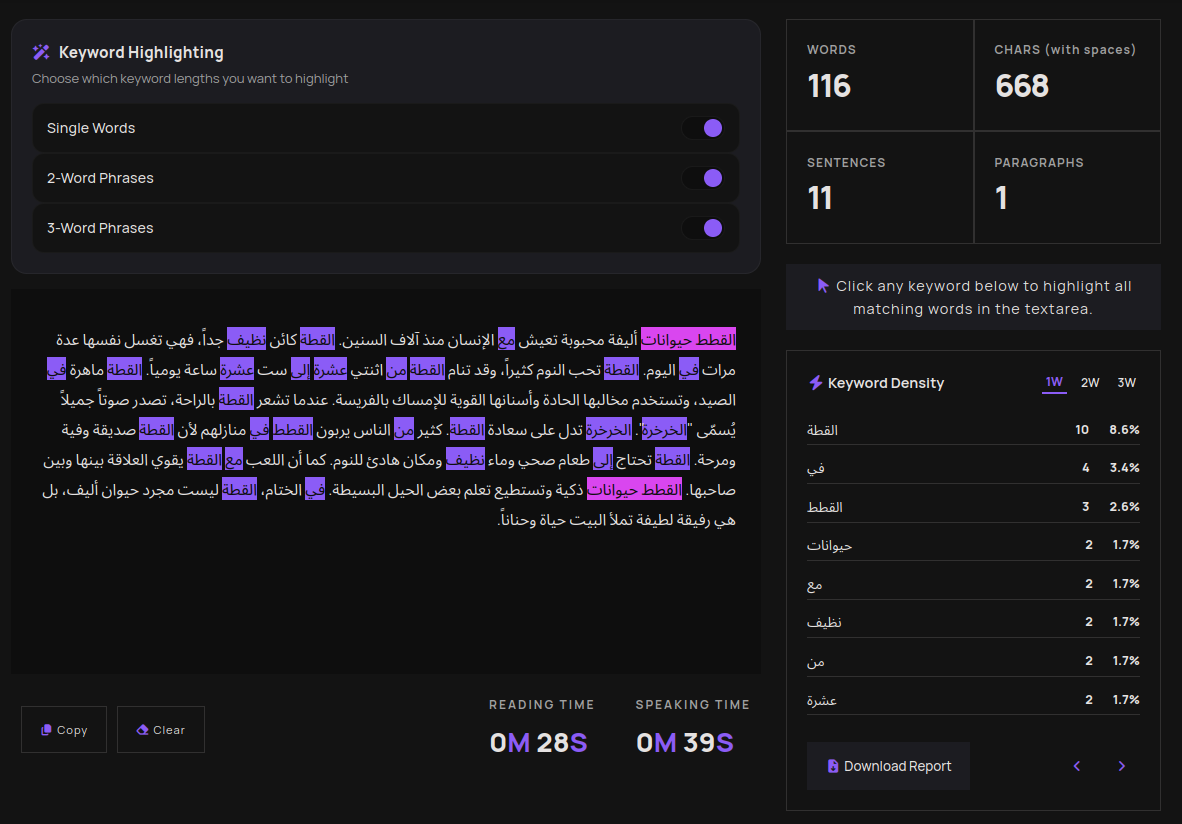
The repetition analysis in this tool makes those patterns visible inside the text. It can identify repeated single words as well as repeated two-word and three-word phrases. Each repetition level has its own visual highlight, making it easier to distinguish a single repeated term from a longer repeated phrase.

Arabic word counter showing word count, repeated words, and keyword density
Arabic word counter in action

This can be helpful when editing an article, product description, essay, or other Arabic text. Instead of searching manually for every occurrence, you can see the repeated patterns while reviewing the content. The feature is not meant to tell you that every repetition is wrong. Some words need to appear many times. The purpose is to help you notice the pattern and decide whether the repetition feels natural.

Control Which Repetitions You See


In an Arabic word counter, highlighting can be useful, but a long piece of text can contain many repeated terms. Showing every highlight at the same time may make the text harder to read. That is why the repetition display gives you control over the three levels of repeated content.

You can choose whether single repeated words, repeated two-word phrases, and repeated three-word phrases are visible. Each level can be turned on or off independently. If you only want to inspect repeated single words, you can hide the other two levels. If you want a broader view, you can display them together.

This approach makes the analysis more practical during editing. You do not have to remove the analysis just because the screen becomes busy. You can reduce the visual information, focus on one type of repetition, and bring the other highlights back when you need them.

The important point is that these controls change what you see, not the text itself. Your writing remains available for normal editing while the highlights act as a visual layer for analysis.

Check Keyword Density in Arabic Content


In an Arabic word counter, keyword density is another way to understand how often a particular word or phrase appears compared with the total amount of text. It can be useful when reviewing an article, checking terminology, or making sure an important subject-specific term has not been used far more often than you intended.

The keyword-density list gives you a broader view than simply looking at the most obvious words in the text. You can see repeated terms together with their occurrence counts and density percentages, which makes it easier to compare the words that appear throughout the document.

Keyword density should be treated as an observation, not a target that every article must reach. There is no single percentage that makes Arabic content good or guarantees better search rankings. Natural writing, useful information, clear organization, and satisfying the reader's purpose matter much more than forcing a keyword into a particular percentage.

That is why the keyword analysis is most useful during review. It can help you notice when one term dominates the text, discover important vocabulary you are using repeatedly, and decide whether some wording could be improved.

Highlight a Keyword Everywhere It Appears


One of the most useful connections in this Arabic word counter is the keyword focus feature. When you select a term from the keyword-density list, the matching occurrences are highlighted directly in the text.

This saves time when you are checking a long document. Instead of reading the entire article and searching for a particular term, you can move from the keyword list straight to its occurrences. The text becomes a visual map of where that term appears.

For example, imagine that you are reviewing an Arabic article and notice that one important word appears much more often than the surrounding terms. Selecting that word lets you inspect its occurrences in context. You can then decide whether each use is necessary, whether some sentences can be rewritten, or whether the repetition is natural because the topic requires it.

This makes the keyword list more than a collection of percentages. It becomes an editing tool that connects numerical information with the actual sentences where the words are used.

Download Your Keyword Density Report


Sometimes you need more than an on-screen result from an Arabic word counter. The tool also lets you download a report containing the keyword-density information from your analysis. This can be useful when you are reviewing content as part of a larger writing or editing process.

A downloadable report can also be useful for translators, editors, content teams, and anyone who needs to keep a record of a text analysis. Instead of taking screenshots or manually copying the results, you can save the report and refer to it later.

The report is particularly useful when keyword frequency is one part of a larger content review. You can keep the analysis beside your draft while making changes, then run the text again when the editing is complete.

Measure Reading and Speaking Duration


An Arabic word counter tells you how much text you have, but sometimes the more useful question is how long that text will take to consume. The tool therefore provides reading and speaking duration estimates alongside the other text statistics.

Reading duration can help when you are preparing an article, presentation, lesson, or other material where you want a quick idea of the time a reader may need. Speaking duration is useful for scripts, speeches, voiceovers, videos, podcasts, and presentations where the text will be spoken aloud.

These figures are estimates rather than guarantees. People read and speak at different speeds, and Arabic texts can vary greatly in difficulty. Familiar vocabulary, technical terms, punctuation, sentence length, and the delivery style of a speaker can all affect the real duration.

Even with that variation, having an estimate gives you a practical starting point. If a script is supposed to fit into a specific time slot, you can use the duration alongside the word count when deciding whether the text needs to be shortened or expanded.

Why Arabic Text Needs Careful Counting


An Arabic word counter needs to account for the characteristics of Arabic text. Arabic letters are connected visually within words, the language uses its own punctuation marks, and Arabic documents can also contain numbers, Latin words, URLs, and other symbols. Diacritics can add another layer when text is fully or partially vocalized.

A useful counter therefore needs to apply clear rules when deciding what belongs to a word, character, sentence, or paragraph. The result should reflect the text the writer is actually analyzing rather than giving a confusing number because different types of content were mixed together.

This matters even more when Arabic and English appear in the same document. A bilingual article, translation draft, product description, or website page may contain both scripts in the same paragraph. Looking only at the final number without understanding what the counter measures can lead to misleading results.

For that reason, Arabic text analysis is not only about displaying a large number at the top of a page. It is about giving writers useful information about the structure and vocabulary of the text they are working with.

Who Can Use an Arabic Word Counter?


Students and Academic Writers

Students can use this Arabic word counter and its measurements to check assignment requirements and review the structure of essays, reports, and research writing. Repetition analysis can also help during editing when the same term appears too often in nearby sentences.

Arabic Bloggers and Content Writers

Bloggers can use word and paragraph counts to review article length while keyword analysis gives another view of the vocabulary used throughout the page. The repetition highlights are useful when polishing an article before publication.

Translators

Translators often need reliable measurements when estimating project size, comparing drafts, or reviewing terminology. Having counts and keyword information together can make the checking stage easier.

Script and Speech Writers

Anyone writing material that will be spoken can use speaking duration as a quick planning reference. This is useful for presentations, educational videos, voiceovers, podcasts, and speeches.

What Makes This Arabic Word Counter (عداد الكلمات) Different?


The main difference is that this Arabic word counter is built around text analysis rather than a single number. You can measure the size of your Arabic text, inspect its structure, review repeated words and phrases, examine keyword density, focus on individual terms, save a keyword report, and estimate how long the content may take to read or speak.

These features are useful individually, but they become more valuable when they are used together. A writer can look at the overall word count, notice a repeated phrase, select it for a closer look, compare the keyword-density information, and then review the text again after editing.

In other words, this is not simply a tool for answering "How many words did I write?" It is a workspace for understanding the text you have written. That makes it useful for anyone who wants more control over the length, structure, repetition, and vocabulary of Arabic content.

If you regularly work with Arabic articles, essays, translations, scripts, or other written content, an Arabic word counter can give you a practical way to review the content. Having these checks together can save time and make the editing process more focused. Instead of switching between separate websites for different measurements, you can analyze the same text from several useful angles in one place.Need to count English text instead? Try our English word countertoo.

A Complete Arabic Word Counter for Text Analysis


A good Arabic word counter should do more than count the spaces between words. It should help you understand the text as a whole. This tool combines essential measurements with visual repetition analysis, keyword-density information, downloadable reporting, and reading and speaking duration.

Whether you are checking an essay, article, reviewing a translation, or other Arabic text, this عداد الكلمات tool gives you more than a simple word total by combining text counts with additional analysis.

How to Use This Arabic Word Counter ?


Hey! 👋 Whether you are writing an Arabic article, checking an essay, or simply counting words, this tool makes the process quick and easy.

01

PASTE YOUR ARABIC TEXT

Copy your Arabic content from a Word document, Google Docs, or any website, then paste it into the text area above. The Arabic word counter starts working as soon as you type or you paste, so there is no button to click.

02

SEE YOUR WORD COUNT INSTANTLY

As soon as you paste your text, the numbers update instantly. The tool shows you:

  • Total word count in Arabic
  • Total characters with spaces included
  • Number of sentences in your text
  • Number of paragraphs

Everything updates live as you type or edit. No need to click anything.

03

SPOT REPEATED ARABIC WORDS

This features is not available in many basic Arabic word counters. Our tool automatically highlights repeated words and phrases inside your Arabic text with colors:

  • Purple highlights single Arabic words that repeat
  • Pink highlights 2-word Arabic phrases that repeat
  • Indigo highlights 3-word Arabic phrases that repeat

This is really helpful when writing Arabic SEO content and avoiding repeated words.

04

CHECK THE KEYWORD DENSITY LIST

Next to or below your text area, you will find a full list of repeated Arabic words or phrases, how many times they appeared, and their keyword density percentage.

05

CLICK A WORD TO FOCUS ON IT

Click any word in the keyword list to highlight every place it appears in the text. Really handy when you want to clean up a specific repeated word without reading the whole text again.

06

USE TOGGLES TO CONTROL THE COLORS

If the colors feel too busy, use the 3 toggles at the top to turn off the ones you do not need:

  • Toggle 1 : show or hide repeated single words
  • Toggle 2 : show or hide repeated 2-word phrases
  • Toggle 3 : show or hide repeated 3-word phrases

That's it ☑️ fast, free, and no account needed. Whether you are a student, blogger, translator, or SEO writer, this Arabic word counter gives you everything you need in one place.
Arabic Word Counter - Frequently Asked Questions

Quick answers to the most common questions we get about counting Arabic words online.

Does this tool count Arabic words?

Yes. Just paste your text and the tool counts Arabic words correctly in real time.

Is this tool free to use?

Yes 100% free. No account, no sign up, no payment. Just open the page, paste your Arabic text and you are done.

Does this tool detect duplicate Arabic words?

Yes. The tool automatically finds and highlights repeated words and phrases in your Arabic text. Single words are highlighted in purple, 2-word phrases in pink, and 3-word phrases in indigo. You can also click any word from the keyword list to highlight every time it appears in the text.

How accurate are the results?

Very accurate. Arabic words are separated by spaces just like English and other languages, so the word count works reliably for Arabic text. The tool counts exactly what is in the text area in real time as you type or paste.

Who is this tool useful for?

Anyone who writes in Arabic like Students checking essay word limits, bloggers writing Arabic articles, translators verifying document length, or SEO writers checking keyword density in Arabic content. The tool covers all of these use cases for free.

Does the keyword density feature work with Arabic text?

Yes. The keyword density list works with Arabic the same way it does with our main page. It shows you the most repeated Arabic words and phrases, how many times each one appears, and what percentage of the total word count it represents. Very useful for Arabic SEO content writing.